Thursday, April 30, 2015

Reading Bingo Update...

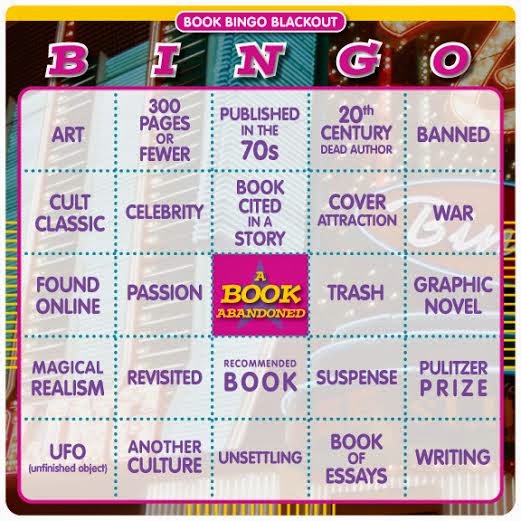
I'm halfway to Book Bingo Blackout. Here's the bingo card courtesy of the Unruly Reader:


And here are the squares I've filled so far:

  • 300 Pages or Fewer: Glaciers by Alexis M. Smith
  • Published in the 70s: Quartet in Autumn by Barbara Pym
  • Book Cited in a Story: The Castle of Wolfenbach by Eliza Parsons
  • Cover Attraction: Stoker's Manuscript by Royce Prouty
  • War: Istanbul Intrigues by Barry Rubin
  • Found Online: When She Was Gone by Gwendolyn Gross
  • Graphic Novel: This One Summer by Jillian & Mariko Tamaki (which I didn't like and do not recommend!)
  • Magical Realism: Girl On A Wire by Gwenda Bond (which I really liked and DO recommend)
  • Recommended Book: Longbourn by Jo Baker
  • Suspense: The Edge of Normal by Carla Norton
  • Another Culture: Children of the Jacaranda Tree by Sahar Delijani
  • Unsettling: Deviant: The Shocking True Story of the Original Psycho by Harold Schechter
  • Writing: The Shelf: From LEQ to LES by Phyllis Rose

Of the squares I have left to fill, I'm most worried about finding a Banned book and a Cult Classic that I actually want to read. (Any suggestions?) Celebrity worries me a little bit, too. The other categories should be fairly easy.  ...  I hope. It's not too late to print out a card and start reading for your own bookish bingo. It's a lot of fun!

Happy Reading!

Monday, April 27, 2015

Two More TBRs...

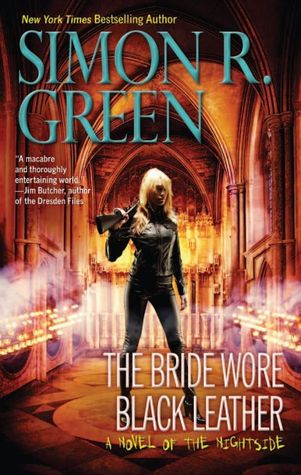
Of the 29 books still on my TBR shelf, I was most in the mood to read The Bride Wore Black Leather this month, but I had to read A Hard Day's Knight first. Both books are part of Simon R. Green's Nightside Series and have been sitting on my shelf for over a year. And if you've never read any of these urban fantasies, they are a lot of fun.

The Nightside is a strange shadowy world hidden in the heart of London where it is always 3:00am. In the Nightside "you can find heroes and villains, gods and monsters, angels and demons".  Here all your dreams can come true...and all your nightmares, too. John Taylor is a PI who lives in the Nightside. He wears a long white trench coat, has an infamous mother, and a gift for finding anyone or anything. And he's one of the people others in the Nightside fear most.


In A Hard Day's Knight, the legendary sword Excalibur shows up on John Taylor's doorstep. John knows he's not worthy to wield that blade, but he's also the only one who can find and awaken King Arthur with it. But then Excalibur gets stolen, and there's an Elven civil war brewing, and if John doesn't fix things fast all of the Nightside will be destroyed. This was a fun ride of a novel, with the last knights of Camelot and Queen Mab, a missing sword, and the usual trouble that always follows John Taylor. I have to say I really enjoyed reading it.


In The Bride Wore Black Leather, a new threat has come to the Nightside on the eve of John Taylor's wedding to Shotgun Suzie, a fearless and feared bounty hunter. The Sun King is determined to end the long night and bring a new dawn to the Nightside. Now John must find a way to stop him, save the Nightside, and still make it to the church on time (or Suzie Shooter just might shoot him). Ironically, considering the title of this book, Shotgun Suzie doesn't even make an appearance until the last 50 pages, but she comes in with a bang. I got the feeling Simon R. Green might be wrapping up the series with this one; if true, it's a good way to go out.  After all, "all the best stories end in a wedding."


Happy Reading!

Friday, April 24, 2015

Reading the Alphabet, Part X...

There aren't a lot of authors whose last names begin with the letter X, at least, not at my library. And the few books I did find on the library shelf weren't ones I wanted to read. I was just about to give up on the letter X altogether when I remembered that April is National Poetry Month. So, I went to check out the 800s and serendipitously stumbled upon Notes on the Mosquito by Xi Chuan (translated by Lucas Klein). I love the imagery in his poetry; and found his later prose poems to be very powerful. But since I'm no literary critic, I'll let Xi Chuan's words speak for themselves.

Here are a few stanzas from Answering Venus (45 Fragments):
1.
night is the sleep of seven wax moths
dawn is the singing of five mermaids
noon is the scratching of three field mice
dusk is the shadow of a crow

8.
If I breathe, what will my heart think?
If I vomit, what will my soul think?

14.
in sudden loneliness
someone who rarely worries can't help but sob

33.
when my life is a mess
my watch is particularly precise

37.
no one has yet tested the pencil
to see how many words it can write


And here's the first part of his prose poem Salute:

Depression. A suspended gong. A leopard dozing in the basement. A spiral staircase. A torch at night. A city gate. Cold that touches a blade of grass beneath an ancient constellation. Concealed flesh. Undrinkable water. An ice cube floating like a giant vessel. Its passenger a bird. A blocked canal. An unborn girl. Unformed tears. Unenforced punishments. Chaos. Balance. Ascent. Blankness... How can depression be discussed without error? Facing flower petals descending at a crossroads, consider the cost of desperate risk-taking.

Depression: an immovable ocean.
Civilization written on the seventh page of suffering.

I want to shout, to force steel to echo, to force mice so accustomed to secrecy to line up before me. I want to shout, but I suppress my voice so I'm not abusive, so I whisper like the wind instead of booming like a cannon. Stronger heartbeats follow a greater silence; I see reserves of water drunk dry, so scream! Oh I want to scream, when a hundred crows cackle I have no golden tongue--I'm a bad omen.

Too many desires, not enough seawater.
Fantasies require capital for sustenance.

Let roses correct our errors, let thunder rebuke us! On a slow journey, no asking the destination. The moment the moth hits the flame it's inopportune to discuss eternity, it's hard to find proof of perfection.

Memory: my textbook
Love: the unfinished business of the heart.


Good, huh?
Happy Reading!
Tuesday, April 21, 2015

Books I wish I'd written:


  • All of Jane Austen's novels. They're smart and witty, they have memorable (and swoon-worthy) characters, and they're still popular 200 years after they were first published. Who wouldn't want to be the author of these amazing books?
  • The Harry Potter Series by J. K. Rowling. Oh how I wish I'd invented her fantabulous world of wizards, wands, Hogwarts, and messenger owls! (I wouldn't mind all that money either.)
  • Then there are the books I wish I were artistic and clever enough to execute, like Nick Bantock's Griffin and Sabine Trilogy (gotta love his artwork!) and Caroline Preston's The Scrapbook of Frankie Pratt, a book told entirely in collage. How I'd love to be able to create something half as wonderful as these books.
  • I also wish I'd written The Riddle-Master of Hed trilogy by Patricia A. McKillip. The writing in these novels is so amazing I find myself lingering over the lyrical prose and rereading certain poetical phrases and passages aloud. Oh, to be able to write like that!
So, what books do you wish you had written?

Sunday, April 19, 2015

The Art of Reading...

Pietro Antonio Rotari - Girl with Book
"She felt a sudden desire for perilous adventures."
--W. Somerset Maugham, The Magician

Thursday, April 16, 2015

Another Classic...

A conversation between Isabella Thorpe and Catherine Morland:
"...when you have finished Udolpho, we will read The Italian together; and I have made out a list of ten or twelve more of the same kind for you."
"Have you indeed? How glad I am! What are they all?"
"I will read you their names directly...Castle of Wolfenbach, Clermont, Mysterious Warnings, Necromancer of the Black Forest, Midnight Bell, Orphan of the Rhine, and Horrid Mysteries. Those will last us some time."
"...but are they all horrid? Are you sure they are all horrid?"

 The Castle of Wolfenbach by Eliza Parsons is one of those "horrid novels" mentioned (and mocked) by Jane Austen in Northanger Abbey. It's a classic Gothic novel of virtue vs. villainy and it is full of Gothic cliches. The main character, Matilda Weimar, is an orphan who must flee her guardian's questionable protection. She stumbles upon Castle Wolfenbach which is purportedly haunted. There she meets Victoria, the Countess of Wolfenbach, who has a scheming and evil husband and a dark secret of her own. In the first 48 pages alone there is an abduction, a mystery, a murder and even arson. Matilda's fate and Victoria's virtuous struggle to free herself from her villainous husband, along with romance and many declarations of love, take up the rest of the novel. But, as Eliza Parsons promises, Providence favors these "poor creatures" in the end.

This isn't the worst novel ever written, but it's not the greatest either. Still, I tried to enjoy it for what it is--one of those "horrid novels" that Jane Austen poked fun of, with damsels in distress, too many counts and countesses to count, overwrought situations, and more than enough moralizing. Towards the end, I found myself heartily agreeing with one of the characters when she exclaimed: "Let's have no more dismals; I declare these last five days have vapored me to death." But I got through it and completed another category in the 2015 Back to the Classics Challenge: read a classic novel written by a woman author. As a bookish bonus, it's also one more book checked off my TBR list.

Happy Reading!

Monday, April 13, 2015

Going deep...

James M. Tabor defines "supercaves" as vast geologic monsters that are miles long and many thousands of feet deep; they are rare and as difficult to conquer as Mt. Everest. Their hazards include darkness, vertical drops, fatal falls, hypothermia, fissures, rock slides, hurricane-force winds, dangerous microbes, asphyxiation and poisonous gases. They also have turquoise pools, cascading waterfalls, beautiful water-carved limestone formations, and caverns immense enough to hold several Greyhound buses. I find them alluring and completely fascinating, but the thought of actually exploring one scares me to death. So I read about them instead.


In Blind Descent, James M. Tabor chronicles the stories of two men--American Bill Stone and Ukranian Alexander Klimchouk--two caves, and two quests to find the deepest place on earth. It's Cheve Cave in southern Mexico vs. Krubera Cave in the Republic of Georgia. Both are incredible supercaves, and both pose great risks to anyone who enters them. And Tabor does a masterful job of taking the reader on an incredible journey deep into the center of the earth. It's a memorable and well-written true life adventure story.


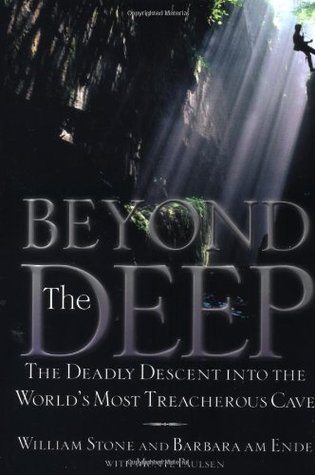
But my favorite caving adventure is told in William Stone's and Barbara am Ende's Beyond the Deep: The Deadly Descent Into the World's Most Treacherous Cave. This firsthand account of Stone's 1994 expedition into Huatla Cave in Mexico is 'unputdownable'. What the cavers experience is scary, and sometimes deadly, and very hard to forget. Talk about going where no one has gone before! Both of these bookish descents into darkness are compelling reads that I absolutely loved!


Happy Reading!