Showing posts with label 1914 fiction. Show all posts

Monday, September 1, 2014

Wrapping up 'Reading 1914'


When I think of Leonard Woolf, I think of Boomsbury, the Hogarth Press and his wife, Virginia; I don't think of compelling fiction novels. But in 1914, Woolf's second novel, The Wise Virgins, was published. It's about Harry Davis, a young cynic, the elegant Camilla Lawrence whom he loves, and the four virginal Garland girls who live next door. Woolf based all of his characters on people he knew. Harry is clearly Leonard himself, while Camilla is based on Virginia. The portrayals are well-drawn, witty, and at times a bit scathing. (Something that didn't exactly go over well when the book first came out.) I found Woolf's writing intelligent, his story well-crafted, and his observations of society cynical, but also honest and amusing. And I really enjoyed this book. Sadly, The Wise Virgins was Leonard Woolf's last fiction novel.

It's also my last book from 1914, which makes me even more sad. I've had a lot of fun this summer reading books published 100 years ago. Every one exceeded my expectations. I read and enjoyed children's books, young adult novels, and literary novels; I also read several other books not published in 1914 that deal with World War I and the events of that year. It's been an excellent summer of reading. Here's a list of the books I read if you want to check them out:

Happy Reading!

Saturday, August 2, 2014

Reading 1914...

Mary Roberts Rinehart has been referred to as 'the American Agatha Christie'. Known for her mysteries, she is considered to be the source of the phrase "the butler did it". Funnily enough, The Street of Seven Stars, which was published in 1914, is not a mystery, but a romance. It's a sweet, well-written story about two Americans in Vienna: Harmony Wells is a talented young violinist studying music; and Peter Byrne is a young doctor studying to be a surgeon. They meet in a pension and soon become friends.
Harmony was as delicately strung, as vibratingly responsive as the strings of her own violin, and under the even lightness of his tone she felt many things that met a response in her--loneliness and struggle, and the ever-present anxiety about money, grim determination, hope and fear, and even occasional despair. 
"It's curious, isn't it?" Peter said. "Here we are, you and I, meeting in the center of Europe, both lonely as the mischief, both working our heads off for an idea that may never pan out!"
Their unconventional friendship is complicated by their lodging arrangements, by their both putting their careers ahead of marriage, by the moral judgments of both strangers and acquaintances, a lack of money, and society in general. Rinehart leaves you guessing whether or not there's going to be a happy ending for these two right up until the very end.

I really enjoyed this 1914 novel. I'd like to read more of Rinehart's books...try one of her mysteries next time. She writes a delightful story. I'm glad my plan this summer to read books that were published 100 years ago led me to this author. At the same time, it makes me a little sad that my summer of reading books from 1914 is fast coming to an end. I only have one more book to go: Leonard Woolf's The Wise Virgins. Hopefully that'll be a good read, too, because the other 1914 books I've read this summer have been a lot of fun.

Happy Reading!

Saturday, July 12, 2014

Reading 1914...

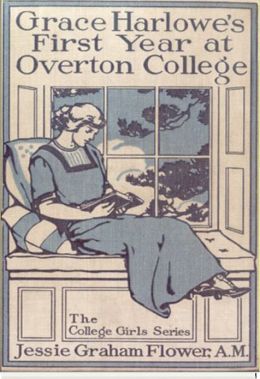
See if the plot of Josephine Chase's novel, Grace Harlowe's First Year at Overton College, sounds familiar. Grace is a brand new student at a well-respected institution. In her first weeks at Overton, she makes some new friends, and some new enemies. She gets into some scrapes; experiences several successes as well as a number of setbacks. Persisting through it all, she ultimately triumphs. It could be the plot of the first Harry Potter book. (Minus the magic, of course.) Instead of playing Quidditch, Grace excels at basketball and helps her Freshman team defeat the dreaded Sophomores. She may not be perfect, but she's earnest, kind, and eager to do well. Here's an example of her youthful idealism:
"Being a freshman is like beginning a garden. One plants what one considers the best seeds, and when the little green shoots come up, it's terribly hard to make them live at all. It is only by constant care that they are made to thrive and all sorts of storms are likely to rise out of a clear sky and blight them. Some of the seeds one thought would surely grow the fastest are total disappointments, while others that one just planted to fill in, fairly astonish one by their growth, but if at the end of the freshman year the garden looks green and well cared for, it's safe to say it will keep on growing through the sophomore and junior years and bloom at the end of four years. That's the peculiarity about college gardens. One has to begin to plant the very first day of the freshman year to be sure of flowers when the four years are over."
I thought Grace's adventures at Overton college were light-hearted and funny. You know how it well end when you begin it, but it's still an enjoyable read. The next book from 1914 on my list is Angela Brazil's The Youngest Girl in the Fifth. I have a feeling that it's going to have a similar plot and end up being a VERY similar read to this one. What do you think?


You can jump back to my other Reading 1914 posts here and here.

Thursday, June 19, 2014

Reading 1914...

The DeVere family is down on their luck. Hosmer DeVere is a stage actor without a part; his two teen-age daughters. Alice and Ruth, worry about household expenses and fret about their father's health. Things seem hopeful when their father lands a part in a new play, but then he loses his voice. What's an actor to do when he can no longer speak his lines? Alice, the livelier of the two girls, determines to do something to help.
"There's no use in two strong healthy girls sitting around, and letting poor old daddy, with a voice like a crow's, doing all the work and worrying...Girls ought to be brought up able to do something so they could earn their living if they had to, instead of sitting around doing embroidery or tinkling on the piano...I'm going to look through the advertisements in the paper tomorrow, and start out after the most promising places."
Before Alice is forced to take a 'common' job, her neighbor, Russ Dalwood, who works at the Comet Film Company offers a solution. He suggests that DeVere become a silent film actor. It seems like the perfect answer to their problems, except for one minor thing: Hosmer DeVere thinks that moving pictures are vulgar and low and he wants no part of them. Alice and Ruth try to convince him otherwise, as does Russ.
"...with all due respect to him, your father is wrong. There's nothing vulgar or low about the movies--except the price...The moving picture shows were once, perhaps, places where nice persons didn't go. But it's different now. All that has changed...The moving pictures are getting better and better all the time."
Needing money, Hosmer eventually gives in and agrees. Alice and Ruth join him at the studio to watch, fascinated by the film-making process. Soon they are acting, too--that's how they become the Moving Picture Girls.

Laura Lee Hope's novel, published in 1914, gives an interesting (and informative) look at those first silent films--how they were rehearsed like plays, filmed in a few days, processed, and quickly distributed to theaters to be viewed by the public. I also liked her characters; Alice is playful and enthusiastic, while her older sister, Ruth, is conventional and quiet. The narrative is dialogue-driven, which gives you a taste for what life was like in 1914. While this book may not add up to much, I thought it was a fun 1914 read. Laura Lee Hope wrote several other novels about the moving picture girls; I just might check them out.

Happy Reading!