Showing posts with label Shakespeare. Show all posts

Thursday, April 18, 2019

A Classic Play...

For several years now, I've been working my way through Shakespeare's plays, trying to read each and every one. (Boy are there a lot of them!) I'm getting close; I only have seven more to go. And one of those is Cymbeline. Which is why I picked it to read for Karen's Back to the Classics Challenge. It's not one of Shakespeare's plays that I was very familiar with, but after reading it, I think they should change the name of the play to Imogen, because I felt like it was more her story than her father's.

.....Alas, poor princess,
Thou divine Imogen, what thou endur'st.--
Betwixt a father by thy stepdame govern'd:
A mother hourly coining plots; a wooer
More hateful than the foul expulsion is
Of thy dear husband ... The heavens hold firm
The walls of thy dear honour; keep unshak'd
That temple, thy fair mind; that thou mayest stand
To enjoy thy banish'd lord and this great land.
So, here's my attempt at explaining the plot of this play. Be forewarned...it gets a little complicated. 

Cymbeline is the king of Britain. His two oldest sons were stolen away in their infancy, leaving him with Imogen, his only daughter, as his sole heir. He wants her to marry Cloten, the son of his second wife, who's now the queen. (And a very conniving one at that.) Instead, Imogen marries Posthumous Leonatus, a noble Roman soldier. Before the marriage is consummated, the king banishes Posthumous from Britain. Before Posthumous leaves, he gives Imogen a bracelet as a token of his love and she gives him a ring, promising to be faithful to him. 

Back in Rome, Posthumous brags about his beautiful and virtuous wife, so much so that his friend, Iachimo, bets him that he can easily seduce her. Posthumous agrees to the bet and off Iachimo goes to Britain to woo Imogen. But the princess refuses his advances. (Just as she's been refusing Cloten's.) Not wanting to lose his bet, Iachimo sneaks into Imogen's rooms at night and steals the bracelet from her arm as proof of her infidelity. When he sees the bracelet, Posthumous believes Iachimo's lies, gets all mad, and sends a letter to his servant, Pisano, ordering him to kill his wife. Pisano helps Imogen escape to Wales instead. There, she disguises herself as a boy named Fidele. While in disguise, she meets her two older brothers who don't know who she is....or that they are actually Cymbeline's sons. (It's another miraculous Shakespearean coincidence!)

Meanwhile, Cloten comes to Wales determined to kill Posthumous, have his way with Imogen, and then bring her back to Britain. Happily, he fails. Imogen never encounters him, but she does drink a potion which causes everyone around her to think she's dead even though she's not. Complicated, right? While all of this is happening, Rome prepares to invade Britain over unpaid tributes. This leads to war, which everyone participates in. In the end, Imogen's two brothers and her husband help Cymbeline defeat the Romans; Cloten is killed; Jupiter makes a brief appearance; Cymbeline and his two sons are brought back together; Iachimo is captured and admits his deceit; and Imogen's honor is restored and she and her penitent husband are reunited at last. Whew. What a play! 

Despite it's convoluted plot, I actually ended up liking this one. And if they ever perform it on a stage near me, I'm definitely going. And congrats if you actually made it to the end of this post!

Happy Reading!


Monday, April 28, 2014

Fourth Classic of 2014...

"How much better is it to weep at joy than to joy at weeping?"

In Shakespeare's plays, the road to love is never smooth or straightforward. Much Ado About Nothing is no exception to this rule. Claudio has fallen in love with Leonato's daughter, Hero, but Don John is determined to disgrace Hero and break up the match before their wedding can take place. Then there are Beatrice and Benedick, who quarrel like better enemies, but who, with a little secret maneuvering by their friends, finally fall in love. It takes five acts of mistaken identity, misunderstanding, and mischief before all is set right, but it ends happily ever after.

I thought this was one of Shakespeare's easier plays to read. It certainly didn't bog down any where. And talk about a perfect title! There is much ado about nothing in this play. Beatrice and Benedick trade barbed jests throughout the play; Don John's plot against Hero and Claudio, while effective at first, is resolved relatively quickly and easily; and no one dies! (Sorry if that's a spoiler.)

While this will never be my favorite Shakespearean play, I did enjoy it, and I'd definitely like to see it performed onstage someday.

"I will live in thy heart, die in they lap, and be buried in they eyes..."


Monday, March 3, 2014

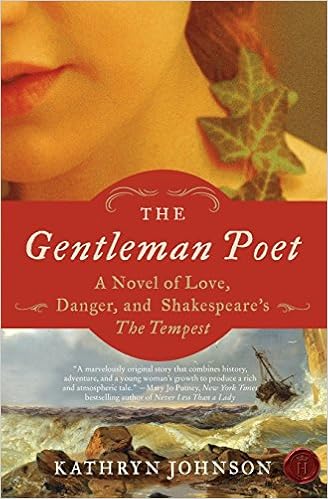
The Gentleman Poet by Kathryn Johnson

10 cents at a library book sale. That's how much I paid for this book. (Don't you just love a bookish bargain?) And after reading it, I have to say it's worth a lot more than that. This novel is a perfect combination of love, survival, adventure, and Shakespeare.


It's 1609. The Sea Venture is sailing for Jamestown when it encounters a storm which causes it to wreck off the coast of Bermuda, the "dreaded Devil's Isles". Among the ship's stranded passengers are Elizabeth Miranda Persons, a young servant girl, and William Strachey, the ship's historian who is really William Shakespeare in disguise. Then there's Thomas Powell, the ship's cook, who hopes to win Elizabeth Miranda's heart.

This novel is a skillful weaving of truth and fiction, history and fantasy, with a little of Shakespeare's The Tempest thrown in for good measure. Johnson ably captures the feel of the 1600s without slowing down the plot. It's mostly Elizabeth Miranda's story, but also the story of the crew and passengers who survived the very real "storm and wreck" of the Sea Venture. Be warned, though, the ending is a bit abrupt. I enjoyed this read. And Bermuda sounds beautiful...I wouldn't mind spending a month, or two, there (without the shipwreck, of course). But I think it's the Shakespearean quotes that Johnson puts at the beginning of each chapter that I liked most of all.

Happy Reading!

Monday, July 15, 2013

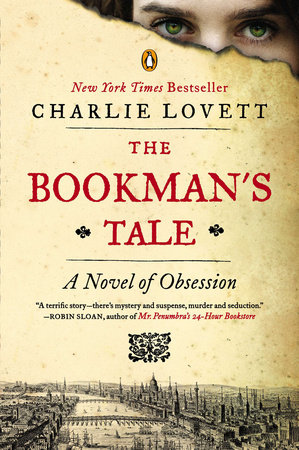
The Bookman's Tale

"I'll bet you never thought the book world was so dangerous."


The Bookman's Tale by Charlie Lovett is the kind of smart literary mystery that I love.  Peter Byerly is an antiquarian bookseller whose wife, Amanda, has recently died.  Grieving, he leaves his home in North Carolina and moves to the English countryside.  In a bookshop in Hay-on-Wye he discovers a Victorian watercolor portrait that looks exactly like his wife.

 "The mystery of the watercolor's origins felt deeply personal and Peter could already feel curiosity and grief melding into obsession.  He had to know where this painting came from - how a hundred-year-old portrait of his wife, who had been born only twenty-nine years ago, had come to be tucked into an eighteenth-century book on Shakespeare forgeries."

Seeking the truth about the painting, Peter stumbles upon "the Holy Grail" of literary treasures--a book that offers proof of Wm. Shakespeare's real identity. But is the book real, or a clever forgery? Peter is determined to uncover the book's long-buried secrets. There's just one problem--he's not the only one hunting for the truth.

This book weaves together the present and the past in a tantalizing mystery that keeps you guessing until the very end.  It completely exceeded my expectations. (Not to mention making me want to read Shakespeare's The Winter's Tale.) If you love literary thrillers, this is a must-own book!  It's that good.

Similar Reads:  Interred With Their Bones by Jennifer Lee Carrell
                          What Time Devours by A.J. Hartley